
Semrush Just Validated “AI Search Trust Signals.” That’s Great. Here’s What They Missed…
- Marcus Sheridan

- Jan 15
- 4 min read
“Well, well, well…the most known SEO tool in the world is using our company name – AI Trust Signals– in one of their biggest reports of the year. Very nice.”
Yep, those were my thoughts as I came across Semrush’s article “AI Search Trust Signals: The Practical Audit (2026 Guide)”. When a company of that size starts using the exact phrase “AI search trust signals,” it tells us something important: the market is settling on the language we believed would change the industry (Hence, naming our software AI Trust Signals) and become the standard vernacular for marketers and business owners around the world.
And here we are…not even out of the first inning of this massive shift in the way people shop, learn, and behave online.
That being said, when I saw the article from Semrush I had another thought:
“I don’t think they know we exist yet. But that’s OK. They soon will.”
Because what Semrush is really doing in that post is essentially telling the world, “Hey, the game is changing. AI systems are deciding what brands they trust enough to mention and cite.”
They frame it around identity, evidence/citations, and technical/UX trust signals—and for many companies, that’s the first time they’ve seen the problem stated that clearly.
So yes, credit where it’s due: they’re pointing in the right direction. But the framework they offer, in our team’s opinion, is incomplete in a way that matters, because it can push businesses to optimize what makes them present rather than what makes them recommended.
Let me explain…
The real issue: “Trust” has levels
Semrush describes trust signals as proof points that help AI systems decide whether your brand is credible and verifiable, and then they offer a quick audit checklist: organization schema, “sameAs” links, consistent NAP (Name, Address, Phone), and HTTPS.

These are absolutely necessary. But from what we’ve discovered, these are "Table Stakes" signals.
If you have consistent NAP and Organization Schema, you have essentially shown your ID at the door. In other words, you are allowed in the building. The AI knows you are a real business.
Hence, Table Stakes.
But being allowed in the building is not the same as being invited to speak on stage (been there, done that).
Here’s what I believe most SEOs and marketers are missing right now. You can have perfect technical hygiene—perfect "identity signals"—and still have zero Authority Signals.
Identity Signals (The Semrush Focus): “I am a real business. I exist. Here is my address.”
Authority Signals (The Recommendation Engine): “I am the expert. I have the data. I am the safest choice for this user.”
If you only optimize for the signals that are easiest to detect and score, you end up with a technically polished brand that still isn’t the one AI systems confidently suggest when buyers ask, “Who should I hire?” or “What’s the best option?”
In other words, you can win the checklist and still lose the recommendation.
A better way to think about it (backed by our data)
We know this isn't just a theory—we’ve measured it. In our recent AI Trust Signals Report, we analyzed over 3,200 companies across the web (that used our software) to see how they stacked up against these new metrics. The data paints a stark picture of why so many brands are being ignored by AI.
If you want a practical order of operations, it’s this:
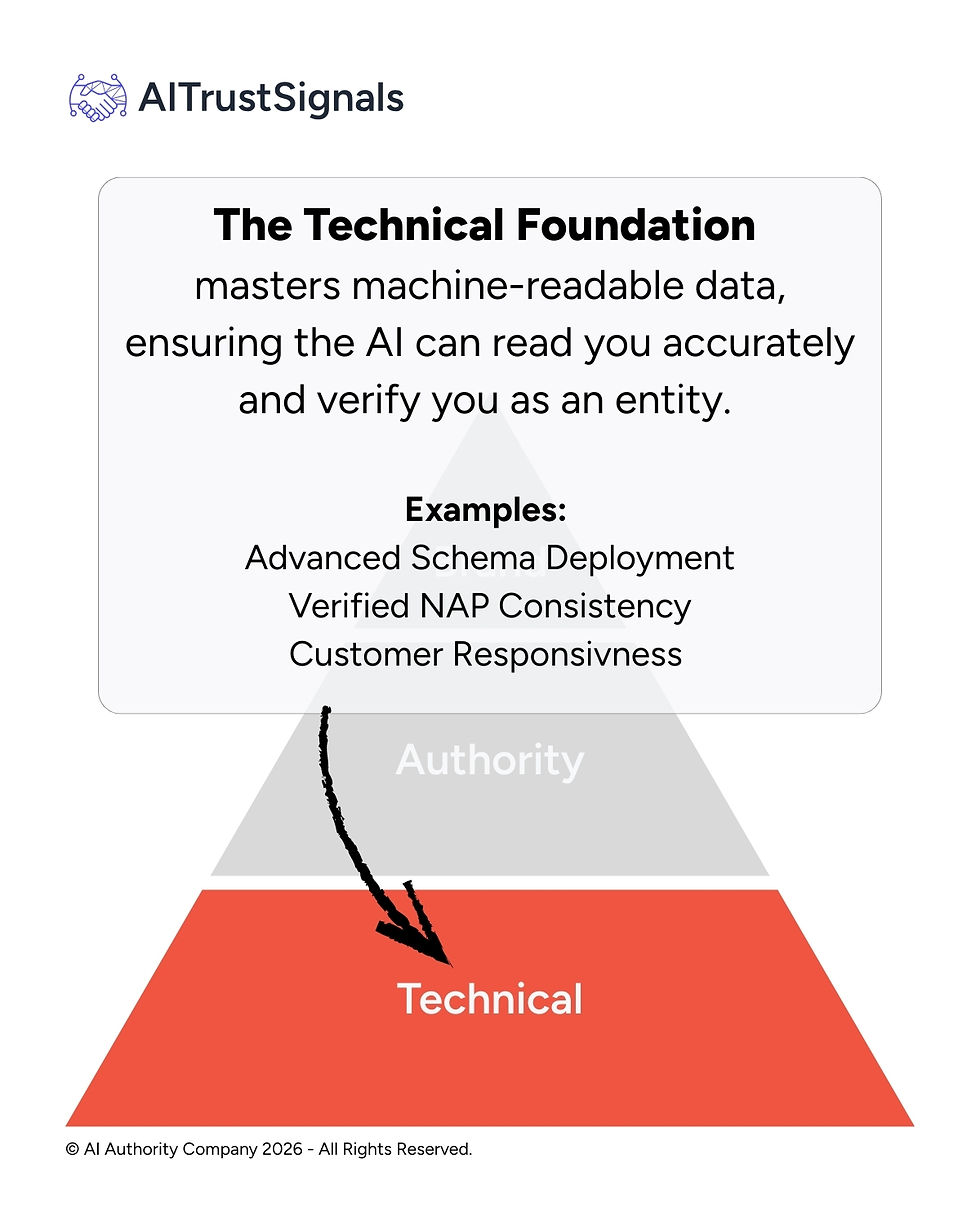
1. First, build the foundation that makes you eligible : Technical Trust Signals.
This is layer-one folks. Without it, you’re asking to be treated like a serious entity while looking anonymous and unaccountable in the eyes of AI.
Yet, despite this being "basic," most brands are missing it. Our data shows that 54% of companies score "Low" on Verified NAP Consistency. That means more than half of the businesses we analyzed can't even agree on their own address across the web. If an AI can't verify where you are, it won't trust who you are. Big problem.

2. Then, build what makes you useful : Authority Trust Signals.
This includes deep, current educational content (think They Ask, You Answer), authoritative outbound citations, and real transparency that proves your claims and reduces buyer friction.
This is where the gap is widest. In our study, 78% of brands failed Advanced Schema Deployment, meaning they aren't translating their expertise into machine-readable code. Even worse, 89% of companies fail to provide Authoritative Outbound Citations. By refusing to cite external sources, these brands look like they are making unsubstantiated marketing claims, which is a high-risk signal to a fact-checking AI.

3. Finally, strengthen what makes you the safer choice: Brand Reputation Trust Signals
These are signals that establish independent validation of your standing in the market.
AI models rely on Claims of Industry Recognition—awards, certifications, and media features—to verify that you are a known, respected entity. Our report found that 38% of companies scored "Low" on Claims of Industry Recognition.
While many brands have achieved this recognition offline, they fail to display it in a way that AI can verify. Without this independent validation, an AI views your brand as unproven—and in a risk-averse environment, unproven means unrecommended.
That’s how you stop optimizing for “being mentioned” and start optimizing for “being chosen.”
Master the AI Search Trust Signals
Semrush publishing “AI search trust signals” is good for everyone building in this space, especially those of us who have been obsessed with the deeper mechanics of trust. I love where they’re going with this and I hope they’ll keep beating the drum.
Now that they’ve helped the market name the problem, I believe it’s time to make sure brands don’t solve the wrong version of it.
So yes, focusing on your technical SEO may get you into the conversation, but authority and reputation decide whether you become the answer.
And moving forward, the answer is where you’ll want to be.
Comments